







Reading more sounds simple in theory. Pick up a book, open it, and keep going.
In practice, it is rarely that easy.
Most people do not struggle because they dislike reading. They struggle because reading has to compete with work, messages, social media, streaming, chores, and dozens of small tasks that fill the day. Even when you genuinely want to read more, it is easy to reach the end of the week and realize that the book on your nightstand has barely moved.
The solution is not to force yourself into reading for hours every day. A lasting reading habit is usually built in a much quieter way. It comes from making reading easy to start, enjoyable to continue, and natural enough to fit into your daily life.
Here is how to build a reading routine that feels sustainable instead of becoming another goal you abandon after a few weeks.
Start Smaller Than You Think You Need To
One of the most common mistakes people make is starting with a goal that sounds ambitious.
You may decide that you will read 50 pages every day, finish a book every week, or spend an hour reading before bed. These goals can feel motivating at first, but they also create pressure.
When life gets busy, the routine suddenly feels difficult to maintain.
A better approach is to begin with a goal that feels almost too easy.
You might start with:
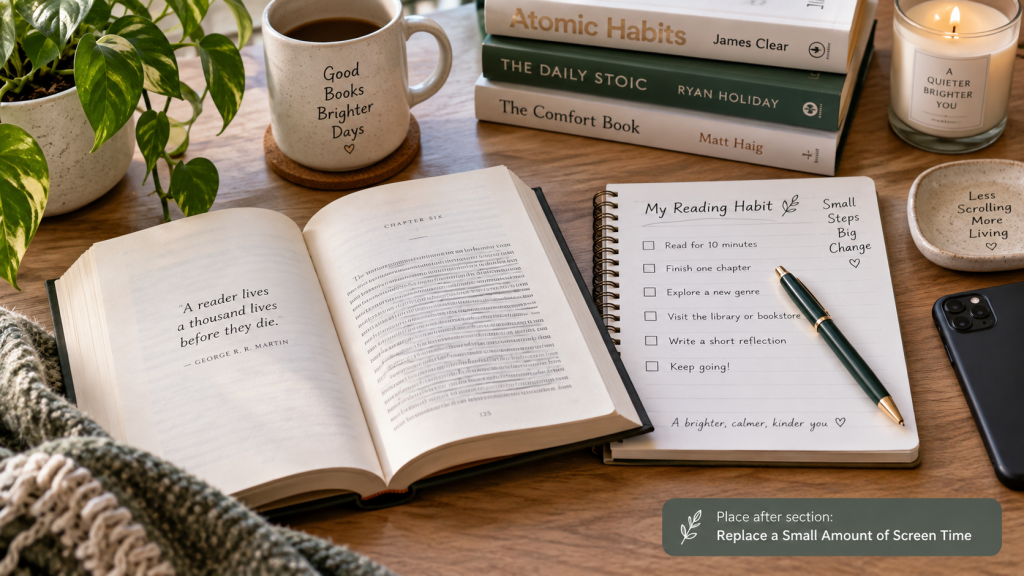
- 10 minutes of reading a day
- 5 pages before bed
- one chapter during lunch
- reading for the length of your morning coffee
The exact number is not important. What matters is making the starting point manageable.
If your daily goal is small, you are more likely to read even on days when you are tired or distracted. Some days, five pages may become twenty. Other days, you may stop after five. Both are fine.
Consistency matters more than intensity in the early stages.
The first goal is not to become someone who reads for two hours every night. The first goal is simply to become someone who reads regularly.
Attach Reading to Something You Already Do
Habits are easier to maintain when they are connected to an existing routine.
Instead of telling yourself, “I will read sometime today,” decide exactly when reading fits into your day.
For example:
- read after breakfast
- read on the train to work
- read during your lunch break
- read after taking a shower
- read before turning off the bedroom light
This works because the existing habit becomes a reminder.
If you already drink coffee every morning, reading can become part of that moment. If you always spend twenty minutes on public transportation, that time can become reading time.
You do not need to redesign your entire schedule.
Look for a small part of the day that already happens consistently, then place reading next to it.
Over time, the connection becomes stronger. You may eventually find yourself reaching for a book automatically when that familiar moment arrives.
Make Your Book Easy to Reach
Environment plays a bigger role in habits than most people realize.
If your book is buried in a drawer, left in another room, or stored somewhere inconvenient, you are less likely to read it.
The easier it is to access, the more likely you are to begin.
Try leaving a book somewhere visible:
- beside your bed
- on your desk
- next to the sofa
- in your bag
- near the place where you eat breakfast
If you read digitally, place your e-reader somewhere noticeable rather than leaving it in a drawer.
The same idea applies to your phone. If you want to read during short breaks, consider moving distracting apps away from your home screen while keeping your reading app easy to access.
Small changes in your surroundings can reduce the effort needed to start.
A good reading habit should not depend entirely on willpower.
Choose Books You Actually Want to Read
Many people lose interest in reading because they choose books based on what they think they should read.
They pick a famous classic, a difficult nonfiction book, or a title everyone else seems to recommend.
Then they struggle through it and assume they are losing their ability to focus.
Sometimes the problem is much simpler: the book is not interesting to them.
Reading for pleasure should include pleasure.
If you enjoy mystery novels, read mysteries. If you prefer biographies, fantasy, history, romance, science, essays, or graphic novels, choose those.
There is no prize for forcing yourself through a book you dislike.
You are also allowed to stop reading a book.
Giving up on one title does not mean giving up on reading.
In fact, being willing to abandon books that do not hold your attention can help protect your reading habit. Every hour spent forcing yourself through a book you hate is an hour that could have been spent discovering something you love.
Keep More Than One Book Available
Not every book fits every mood.
Sometimes you want something thoughtful and challenging. Other times you want something light and entertaining.
Keeping two or three books available gives you flexibility.
You might have:
- a novel for the evening
- a nonfiction book for weekends
- a short story collection for busy days
This prevents reading from becoming dependent on a single book.
If you are not in the mood for one title, you can switch instead of skipping reading entirely.
The goal is not to finish books in a perfectly organized order. The goal is to keep reading enjoyable and accessible.
Replace a Small Amount of Screen Time
You do not need to eliminate social media, television, or entertainment apps to become a regular reader.
A more realistic strategy is to replace a small portion of screen time.
For example, if you normally spend forty minutes scrolling before bed, try reading for the first fifteen minutes instead.
If you usually check your phone while waiting for an appointment, open a book or reading app.
These small moments add up.
Ten minutes in the morning and fifteen minutes at night may not feel like much, but over a week that becomes nearly three hours of reading.
The key is not finding huge blocks of free time.
It is noticing the small pieces of time that already exist.
Stop Thinking You Need the Perfect Reading Environment
A quiet room, comfortable chair, warm drink, and free evening sound ideal.
But if you wait for the perfect atmosphere, you may not read very often.
Learn to read in ordinary conditions.
Read while waiting for dinner to cook. Read during a commute. Read while waiting for someone. Read for ten minutes before a meeting.
A strong habit becomes flexible.
It can survive days when your schedule is messy.
Of course, creating a peaceful reading environment can make the experience more enjoyable. But it should be a bonus rather than a requirement.
The easier it is to read in different situations, the more opportunities you will find.
Track Your Progress Without Turning Reading Into a Competition
Tracking can be motivating.
You might keep a simple list of the books you finish or mark each day you read on a calendar.
Seeing progress creates a sense of momentum.
However, tracking can become unhelpful if it turns reading into a numbers contest.
If you focus too much on how many books you finish, you may start choosing shorter books simply to increase the count. You may rush through chapters instead of enjoying them. You may even feel guilty for reading slowly.
A useful reading tracker should encourage consistency, not pressure.
Consider tracking things such as:
- days you read
- books you enjoyed
- memorable ideas or quotes
- subjects you want to explore next
These details remind you why reading matters beyond simply completing another title.
Create a Reading List, but Keep It Flexible
Knowing what you want to read next helps prevent long gaps between books.
If you finish one book and have no idea what to choose afterward, it may take days or weeks before you start another.
Keep a short reading list somewhere convenient.
It could contain five or ten titles you are genuinely interested in.
You can find ideas from friends, bookstores, libraries, podcasts, online reviews, or authors you already enjoy.
But avoid turning your list into an obligation.
A reading list should feel like a menu, not homework.
Your interests may change. A book that sounded exciting six months ago may no longer appeal to you.
That is completely normal.
Update the list whenever necessary.
Use Audiobooks When Traditional Reading Is Difficult
Reading does not always require sitting down with a physical book.
Audiobooks can help you stay connected to books during parts of the day when traditional reading is difficult.
You might listen while:
- walking
- commuting
- exercising
- cleaning
- cooking
- doing repetitive tasks
For some people, audiobooks dramatically increase the amount they read because they turn previously unused time into reading time.
They can also be useful for books with strong storytelling or narration.
You do not have to choose between printed books, e-books, and audiobooks.
Use whichever format fits the situation.
The most sustainable habits are often the most flexible ones.
Protect Your Reading Time From Small Distractions
Many people sit down to read and immediately check a notification.
A few minutes later, they realize they have been scrolling for twenty minutes.
If this happens often, create a small boundary around your reading time.
Put your phone across the room. Turn off notifications for fifteen minutes. Use airplane mode if necessary.
You do not need extreme digital discipline.
You simply need to make distraction slightly less convenient.
Even a short period of uninterrupted reading feels very different from reading while constantly switching attention.
Over time, your ability to focus may improve naturally.
Do Not Worry About Reading Speed
Fast reading is often treated as a skill everyone should develop.
But speed is not always useful.
Some books are easy to read quickly. Others require time.
A complicated history book, philosophical essay, or detailed science book may naturally take longer than a thriller.
That does not mean you are reading badly.
The purpose of reading is not to move your eyes across pages as quickly as possible.
It is to understand, enjoy, imagine, learn, or think.
Let the book determine the pace.
If you want to reread a paragraph, do it. If you want to stop and think, stop.
A sustainable reading habit should respect curiosity rather than rush it.
Give Yourself Permission to Miss a Day
Missing one day does not destroy a habit.
The problem usually begins when one missed day turns into a week, then a month.
If you skip reading because you are tired, traveling, busy, or simply not in the mood, do not treat it as failure.
Just return to the habit the next day.
This mindset is important because perfection makes habits fragile.
If your rule is “I must read every single day,” one missed day can feel discouraging.
If your rule is “I return to reading regularly,” the habit becomes much more resilient.
Life will interrupt your routines sometimes.
A lasting habit is one that can restart easily.
Make Reading Social When It Helps
Reading is often seen as a solitary activity, but other people can make it more enjoyable.
You might join a book club, discuss books with friends, share recommendations, or follow readers whose tastes are similar to yours.
Talking about a book often makes the experience more memorable.
It can also introduce you to authors and genres you may never have discovered on your own.
However, social reading should still support your interests.
You do not need to read every popular title simply because everyone else is discussing it.
Use recommendations as inspiration, not pressure.
Build a Reading Identity
One of the strongest changes happens when reading becomes part of how you see yourself.
Instead of saying, “I am trying to read more,” you begin to think, “Reading is something I do.”
That shift happens gradually.
Every time you pick up a book instead of scrolling for another ten minutes, you reinforce the habit.
Every time you carry a book in your bag, visit a library, or read before bed, you create evidence that reading belongs in your life.
You do not need to call yourself a serious reader.
You simply need to make reading normal.
The habit becomes much easier when it stops feeling like a temporary challenge.
A Simple Reading Routine You Can Start Today
If you are unsure where to begin, keep it simple.
Choose one book you genuinely want to read.
Pick one reliable moment in your day.
Read for ten minutes.
Leave the book somewhere visible when you are finished.
Repeat the same routine tomorrow.
That is enough.
You can increase the time later if you want.
You can add audiobooks, reading lists, tracking systems, or longer weekend sessions once the habit feels natural.
But none of those things are necessary at the beginning.
The most important step is creating a routine that feels easy to repeat.
Final Thoughts
A lasting reading habit is not built through pressure.
It is built through convenience, curiosity, and repetition.
You do not need to finish dozens of books every year. You do not need to read difficult classics. You do not need a perfect reading schedule.
You only need a system that makes it easy to return to books again and again.
Start small. Choose books you enjoy. Keep them close. Use the quiet moments already hidden inside your day.
Eventually, reading can stop feeling like something you are trying to fit into your schedule.
It simply becomes part of your life.